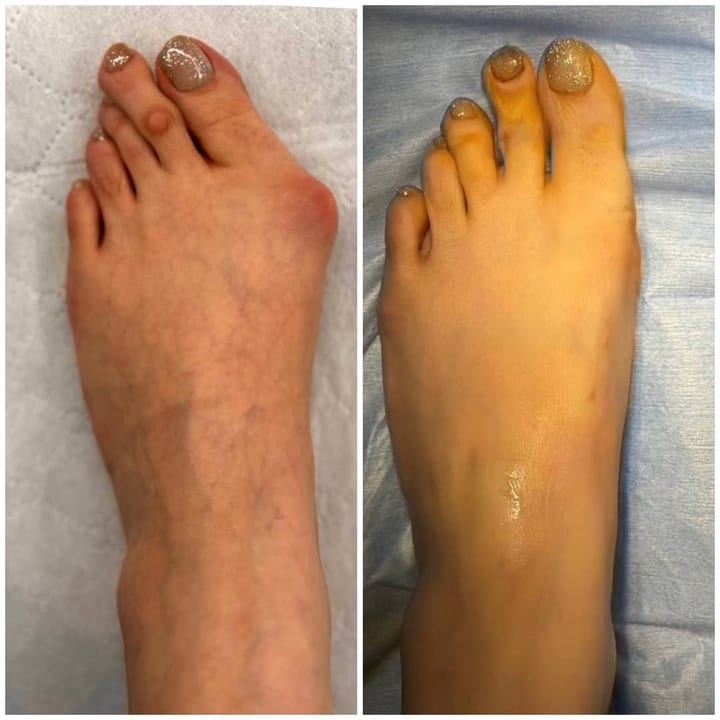
What it is
The bump on the side of the foot is usually mistaken for extra bone. It is not. The first metatarsal, the long bone behind the big toe, drifts inward, and the head of that bone becomes prominent under the skin. The big toe then leans across towards the second toe.
Once the alignment shifts, the tendons that cross the joint no longer pull in a straight line and start to make the deformity worse. That is why bunions tend to progress slowly rather than stay still.
Why it happens
- Inherited foot shape. By far the biggest factor. Bunions run in families and often appear early.
- Ligamentous laxity, and instability of the joint at the base of the first metatarsal.
- A flat or pronated foot, which loads the inner border of the forefoot.
- Footwear. Narrow, high shoes make an existing tendency worse and more painful, but they are not the root cause.
What it causes
- Pain over the prominence, worse in enclosed shoes.
- Difficulty finding shoes that fit.
- Load transferring to the lesser toes, causing pain under the ball of the foot.
- Crowding of the second toe, which can be pushed up into a hammer toe or dislocate.
- In advanced cases, arthritis of the big toe joint.
Treatment without surgery
Non-operative measures relieve symptoms. None of them straightens the toe.
- Wide, soft-toed shoes with a low heel, which is the single most effective measure.
- Bunion pads and silicone spacers for comfort.
- An orthosis where the foot is also pronated.
- Simple analgesia during flare-ups.
Night splints and toe-straightening devices are frequently sold. They do not correct the bone alignment.
The operation
The correction is chosen from the radiograph and the examination, not from a preference for one technique. The main variables are how far the metatarsal has drifted, whether the joint at its base is stable, whether the toe itself is rotated, and whether there is arthritis.
- Distal osteotomy (chevron and related cuts) for mild to moderate deformity. The head of the metatarsal is cut and shifted across, then fixed with one or two small screws.
- Minimally invasive osteotomy, performed through a few millimetre incisions with a burr under radiographic guidance and fixed with screws. Suitable for a wide range of mild and moderate deformities.
- Scarf and other shaft osteotomies for larger corrections.
- Lapidus fusion of the joint at the base of the first metatarsal, where that joint is unstable or the deformity is severe. It addresses the deformity at its origin and is the more durable choice in that group.
- Soft-tissue balancing of the joint capsule and the adductor, done alongside the bone correction.
- Akin osteotomy of the toe itself, added when the toe remains angled after the metatarsal is corrected.
Screws are usually left in place. They only need removing if they become prominent and irritate.
What recovery actually asks of you
The predictable part is bone healing, which takes about six weeks. The unpredictable part is swelling, which is normal for months and is the single most common source of disappointment when nobody has warned about it. Keeping the foot elevated in the first two weeks makes a real difference to how quickly it settles.